12.5.23
28.8.18
MR. JONES
During the winter of 1945,1 lived for several months in a rooming house
in Brooklyn. It was not a shabby place, but a pleasantly furnished, elderly
brownstone and always kept tidy by its owners, two sisters who never got married.
Mr. Jones lived in the room next to mine. My room was the smallest in the
house, his the largest, a nice big sunshiny room, which was just as well,
because Mr. Jones never left it: all his needs, meals, shopping, laundry, were
dealt with by the two middle-aged landladies. Also, he was not without
visitors; on the average, a half-dozen various persons, men and women,
young, old, in-between, visited his room each day, from early morning until
late in the evening. He was not a drug dealer or a fortune-teller; no, they just
came to talk to him and apparently they gave him small gifts of money for his
conversation and advice. If not, he had no obvious means of support.
I never had a conversation with Mr. Jones myself, a circumstance I've
often since regretted. He was a handsome man, about forty. Thin,
black-haired, and with a distinctive face which you can always remember, a
long face, high cheekbones, and with a birthmark on his left cheek, a small
red mark shaped like a star. He wore gold-rimmed glasses with pitch-black
lenses; he was blind, and crippled, too - according to the sisters, he had been
unable to use his legs since a childhood accident, and he could not move
without crutches. He was always dressed in a neatly pressed dark grey or
blue suit and a dark-coloured tie - as though about to set off for a Wall Street
office.
However, as I've said, he never left the house. I had no idea why they
came to see him, these rather ordinary-looking people, or what they talked
about, and I was too busy with my own affairs to think about it. When I did,
I imagined that his friends had found in him an intelligent, kindly man, a
good listener they could confide in and talk with over their troubles: someone
between a priest and a therapist.
Mr. Jones had a telephone. He was the only tenant with a private line.
I moved to Manhattan. While the landladies offered me tea and cakes in
their lace-curtained sitting room, I asked them about Mr. Jones.
The women lowered their eyes. Clearing her throat, one said: "It's in the
hands of the police."
The other offered: "We've reported him as a missing person." The first
added:
"Last month, twenty-six days ago, my sister carried up Mr. Jones's
breakfast, as usual. He wasn't there. All his belongings were there."
"It's strange—"
"— how a man totally blind, a helpless cripple..."
Ten years pass.
Now it is a zero-cold December afternoon, and I am in Moscow. I am
riding in a subway car. There are only a few other passengers. One of them is
a man sitting opposite me, a man wearing boots, a thick long coat and a
Russian-style fur cap. He has bright eyes, blue as a peacock's.
After a doubtful moment, I simply stared, for even without the black
glasses, there was no mistaking that long distinctive face, those high
cheekbones with the single red star-shaped birthmark.
I was just about to cross the aisle and speak to him when the train pulled
into a station, and Mr. Jones, on a pair of fine strong legs, stood up and
hurried out of the car. Rapidly the train door closed behind him.
in Brooklyn. It was not a shabby place, but a pleasantly furnished, elderly
brownstone and always kept tidy by its owners, two sisters who never got married.
Mr. Jones lived in the room next to mine. My room was the smallest in the
house, his the largest, a nice big sunshiny room, which was just as well,
because Mr. Jones never left it: all his needs, meals, shopping, laundry, were
dealt with by the two middle-aged landladies. Also, he was not without
visitors; on the average, a half-dozen various persons, men and women,
young, old, in-between, visited his room each day, from early morning until
late in the evening. He was not a drug dealer or a fortune-teller; no, they just
came to talk to him and apparently they gave him small gifts of money for his
conversation and advice. If not, he had no obvious means of support.
I never had a conversation with Mr. Jones myself, a circumstance I've
often since regretted. He was a handsome man, about forty. Thin,
black-haired, and with a distinctive face which you can always remember, a
long face, high cheekbones, and with a birthmark on his left cheek, a small
red mark shaped like a star. He wore gold-rimmed glasses with pitch-black
lenses; he was blind, and crippled, too - according to the sisters, he had been
unable to use his legs since a childhood accident, and he could not move
without crutches. He was always dressed in a neatly pressed dark grey or
blue suit and a dark-coloured tie - as though about to set off for a Wall Street
office.
However, as I've said, he never left the house. I had no idea why they
came to see him, these rather ordinary-looking people, or what they talked
about, and I was too busy with my own affairs to think about it. When I did,
I imagined that his friends had found in him an intelligent, kindly man, a
good listener they could confide in and talk with over their troubles: someone
between a priest and a therapist.
Mr. Jones had a telephone. He was the only tenant with a private line.
I moved to Manhattan. While the landladies offered me tea and cakes in
their lace-curtained sitting room, I asked them about Mr. Jones.
The women lowered their eyes. Clearing her throat, one said: "It's in the
hands of the police."
The other offered: "We've reported him as a missing person." The first
added:
"Last month, twenty-six days ago, my sister carried up Mr. Jones's
breakfast, as usual. He wasn't there. All his belongings were there."
"It's strange—"
"— how a man totally blind, a helpless cripple..."
Ten years pass.
Now it is a zero-cold December afternoon, and I am in Moscow. I am
riding in a subway car. There are only a few other passengers. One of them is
a man sitting opposite me, a man wearing boots, a thick long coat and a
Russian-style fur cap. He has bright eyes, blue as a peacock's.
After a doubtful moment, I simply stared, for even without the black
glasses, there was no mistaking that long distinctive face, those high
cheekbones with the single red star-shaped birthmark.
I was just about to cross the aisle and speak to him when the train pulled
into a station, and Mr. Jones, on a pair of fine strong legs, stood up and
hurried out of the car. Rapidly the train door closed behind him.


27.8.18
Reader at work 2 Download pdf
Reader at work 2 Download pdf, indir,
READER AT WORK 2 DOWNLOAD
This book is a collection of the reading sections of the exam papers prepared in the Department of Basic English in the last ten years. It is intended to provide students with supplementary material for EFL reading practice and exam preparation as it is believed that the reading material in the main textbooks is not always sufficient for this purpose. In their English-medium academic mainstream, reading will be of utmost importance for our students; therefore, we believe that they should be encouraged to read as much as possible outside class and we hope that this book will equip both the students and the teachers with enough means to emphasize reading comprehension and vocabulary development.
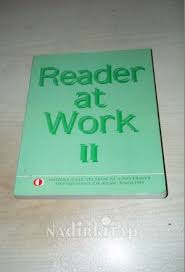
The material in this book has been graded according to text difficulty and the level of the exercises so that it will serve the needs of our students - from the beginner level to intermediate - in the first semester. There are 204 passages in the book, which will enable each student to read extensively at his own level and to move on to the more advanced texts for challenge. In selecting the passages, an attempt has been made to include a variety of topics and text types so as to promote reading for pleasure as well. Finally, the material has been edited to maintain a reasonable level of consistency in the exercise types throughout the book. Although it is prepared with the students of the Department of Basic English in mind, we believe that this book will help any enthusiastic student of English as a foreign language. If the book proves to be beneficial, we will consider ourselves useful.
READER AT WORK 2 DOWNLOAD
This book is a collection of the reading sections of the exam papers prepared in the Department of Basic English in the last ten years. It is intended to provide students with supplementary material for EFL reading practice and exam preparation as it is believed that the reading material in the main textbooks is not always sufficient for this purpose. In their English-medium academic mainstream, reading will be of utmost importance for our students; therefore, we believe that they should be encouraged to read as much as possible outside class and we hope that this book will equip both the students and the teachers with enough means to emphasize reading comprehension and vocabulary development.
The material in this book has been graded according to text difficulty and the level of the exercises so that it will serve the needs of our students - from the beginner level to intermediate - in the first semester. There are 204 passages in the book, which will enable each student to read extensively at his own level and to move on to the more advanced texts for challenge. In selecting the passages, an attempt has been made to include a variety of topics and text types so as to promote reading for pleasure as well. Finally, the material has been edited to maintain a reasonable level of consistency in the exercise types throughout the book. Although it is prepared with the students of the Department of Basic English in mind, we believe that this book will help any enthusiastic student of English as a foreign language. If the book proves to be beneficial, we will consider ourselves useful.
24.8.18
ASH FROM A VOLCANO: IT MAY REMAIN ALOFT

The 1982 eruption of Mexico's El Chichon volcano sent vast
quantities of ash high into the stratosphere. If a University of New
Mexico scientist is correct, the ash which went up hasn't all come down
yet.
Most scientists assume that volcanic ash falls to earth within a year
or two after an eruption. But Frans J.M. Rietmeijer says that he can
show that tiny particles collected in 1985 by a balloon above Texas had
come out from El Chichon. What's more, he believes that because
volcanic particles are flat and fall more slowly than spherical particles,
thev may remain aloft for a hundred years or more. The balloon was
originally designed to collect particles of meteoric origin. It took
samples of the air at an altitude of 35 kilometres - near the top of El
Chichon's plume of ash. Rietmeijer says the particles that he analysed
chemically match the ash from the volcano.
ADVERTISING
Advertising is about creating images, and this is especially true when
advertising food and drink. What the food looks like is more important
than what it tastes like.
To sell food successfully, it must look appetizing. Milk must look
cold, bread must look freshly-baked, fruit must look juicy. Television
advertising of food often uses movement. Obviously, food looks
especially tasty when it moves. Chocolate sauce looks more delicious
when you see it being poured over ice cream than if it is in a bowl.
Sound effects - but not background music - also help to sell food:
sausages frying in a pan are mouth-watering. A TV advertisement for a
brand of coffee had the sound of coffee being poured in the
background. The advertisement was so successful that it lasted five
years.
The colour of food and the colour of packaging are also very
important. If the colour of the food looks wrong, people won't eat it
because they associate food with certain colours. Nobody would eat
blue bread or drink blue beer. Therefore, in advertising food, purple
gray and, in some cases, white are unpopular colours.
How people expect something to taste often influences how it
actually does taste. Researchers gave some mineral water to two groups
of people. They told one group that the water was mineral water and
asked: "What does it taste like?" The answer was: "It tastes nice." Then
the researchers told the other group that the mineral water was tap
water. The second group said the water tasted a bit strange and not very
nice. The word 'tap' created an unpleasant image of chlorine.
It is the same for packaging. A food manufacturer was trying to
decide whether to sell his product in a glass jar or a can. He gave a
group of people the same product in both a glass jar and a can and
asked them to taste it. They all claimed that the product in the glass jar
tasted better.
So it seems to be true, image is everything.
ARE YOU REALLY A NON-SMOKER?

The results of a study done in Japan showed that wives who did not
smoke but were exposed to their husbands' cigarette smoke developed
lung cancer at a much higher rate than those whose husbands did not
smoke. For them, the risk of developing lung cancer was directly
related to the amount their husbands smoked. This was about one-third
of the risk of developing lung cancer taken by smokers.
This study strengthens the thesis that the effect of tobacco smoke on
the non-smoker, which has been called passive, secondhand or
involuntary smoking, may be a cause of lung cancer in the general
population.
The study also strengthens the evidence which implies that passive
smoking is a health hazard. A study published last year suggested that
passive smoking might cause damage to the small airways in the lungs
of non-smokers. Other studies have suggested that passive smoking
may worsen non-smokers' pre-existing chronic heart and lung
conditions.
Lung cancer is a major health problem throughout the world. It is
estimated that in 1997, 122,000 Americans will be told that they have
lung cancer. Moreover, only about 10 per cent of these will live another
five or more years because of the ineffectiveness of available
treatments.
The lungs are the leading sites of cancer in the U.S. among men who
are 35 and over. In women, lung cancer deaths are rising so fast that
experts expect them to exceed breast cancer deaths by the middle of this
decade, becoming the No.l cancer killer of women.
As evidence linking the rise of lung cancer with cigarette smoking
has increased, many experts have theorized that passive smokers have a
greater risk of developing lung cancer than those who are not exposed
to smoke. Such theories are based on the knowledge that second-hand
smoke of cigarettes contains large amounts of toxic substances.
23.8.18
HOLIDAYS,

More than 300 million people go abroad for their holidays each year,
and most of them prefer spending less on food and clothes than on
holidays. Choosing the ideal holiday is not always easy, but today there
is a wide range of choice, and it is easy to find something to suit your
taste and pocket.
Some people like planning their holiday independently. Others find
making arrangements on their own difficult, so they prefer to book a
package tour. It depends on where you are going, how much money
you have and whether you are travelling alone or with friends and
family.
The obvious advantage of a package holiday is that it is simple to
organise. You book the holiday through a travel agent, and transport
and accommodation are all arranged for you. You don't have to worry
about how you will get there or where you will stay. All you have to do
is pay the bill. If you take an independent holiday, on the other hand,
you can spend a lot of time and money checking complicated timetables,
chasing - looking for - cheap flights and trying to make hotel
reservations in a language you can't even speak. In addition, package
holidays are often incredibly cheap. For the price of a good dress, you
can have a fifteen-day holiday in a holiday resort abroad, including
accommodation, meals and air travel. A similar independent holiday can
cost you much more.
However, planning your own holiday has several advantages. You
are free to choose where and when you want to go, how you want to
travel, and how long you want to stay. You can avoid the large holiday
resorts which are often crowded with holidaymakers on package tours.
You can eat the food of the region at reasonable prices at local
restaurants instead of the international dishes that they serve in holiday
resorts. Moreover, although package holidays are usually cheap, they
are not always cheaper. If you are willing to take a little trouble, you
may be able to save money by organising a foreign holiday yourself.
Subscribe to:
Posts (Atom)