It is widely believed that the world's population has exploded because of the improvements in medical science, which has naturally led to improved standards of public health. Infant mortality has.been greatly reduced and the average length of life has been extended on a great scale.
Demographers, or population statisticians, are less alarmed by the
absolute rise in the world population figures than by the increase in the rate of growth. They estimate that it will take only about 30 years for the world population to double. Pessimists expect this soaring growth to continue until the limits of food, space and natural resources are forced. It is not easy to find solutions to problems caused by population growth.
In fact, effective action is lacking because of our inability to decide exactly where the problems lie. For example, many millions of people do not have enough to eat, but at the same time we could argue that the world is not over-populated in relation to its food supply at the present time. The total cultivable land is more than 15 billion acres. Using modem agricultural methods, we could produce more than enough food for the present
population of about 5 billion.
It appears, then, that the world's population could be almost three times as large before there is a serious shortage of food. But it is unlikely that all the cultivable land would be used for food production. If this were done, there would not be any land left to meet man's increasing demand for houses, factories, airports, roads and other facilities.
A. Find words or phrases in the text which mean the same as the following.
1. death in infancy (paragraph 1):
2. population statisticians (paragraph 2):
3. extremely rapid increase (paragraph 2):
4. suitable for agriculture (paragraph 3):
B. Mark the best choice.
1. Which of the following is not a consequence of the improvements in medical
science?
a) Fewer deaths in infancy.
b) Longer length of life.
c) Decrease in population.
d) Higher public health standards.
4.7.11
EARTHQUAKES
destructive happenings of nature that man experiences. The effects of an earthquake are often terrible. Earthquakes have caused the death of many human beings, much suffering, and great damage. Today, the study of earthquakes has grown greatly as scientists all over the world study the causes of earthquakes. Scientists hope that their studies will improve the ways of predicting earthquakes and also develop ways to reduce their destructive effects. The scientific study of earthquakes is somewhat new. Until the18th century, few factual descriptions of earthquakes were recorded.
In general, people did not understand the cause of earthquakes. Many believed that they were a punishment from God. One early theory was that earthquakes were caused by air rushing out of caverns deep in the interior of the earth.
On November 1, 1755, a serious earthquake occurred near Lisbon,
Portugal. Shocks from the quake were felt in many parts of the world. After the quake, Portuguese priests were asked to observe the effects and to make written records. These records were the first scientific steps to write down the effects of an earthquake. Since that time detailed records have been kept of almost every major earthquake.
Most earthquakes occur in areas around the Pacific Ocean. This
belt of areas is called the 'ring of fire' and includes the Pacific coasts of North and South America, the Aleutian Islands, Japan, Southeast Asia, and Australia. Half a million people within the 'ring of fire' have died because of earthquakes and much valuable property has been severely damaged or destroyed.
An earthquake is the oscillatory, sometimes violent, movement of
the earth's surface that comes after a release of energy in the crust of the earth. Most destructive quakes are caused by the dislocation of the crust. Forces from beneath the surface of the earth cause the crust to bend and then break and the rocks on the surface move into a new position. The breaking of the rocks causes vibrations called 'seismic waves'. These vibrations travel from the source of the earthquake to distant places along the surface of the earth. The seismic waves cause the entire planet to tremble or ring like a bell.
The vibrations produced by earthquakes are discovered, recorded,
and measured by instruments called seismographs. Vibrations are of two general types: surface waves and body waves. Surface waves travel along the earth's surface and body waves travel through the earth. Surface waves usually have the strongest vibrations and probably cause most of the damage done by earthquakes.
Currently, scientists are making studies to predict earthquakes. At
the present time, scientists do not have the knowledge required to
predict the time and size of earthquakes. However, a large group of
scientists at the National Centre for Earthquake Research in
California, has been able to predict the areas where earthquakes might occur. Research at the centre about the physical and chemical nature of rocks and their behaviour under the force of an earthquake will help engineers to design and build structure for areas that often suffer from earthquakes.
A. Complete the following sentences.
1. Line 48, 'their behaviour' refers to the behaviour of .
2. The 'ring of fire* is the belt of areas around the Pacific Ocean where
3. Seismographs
the vibrations caused by earthquakes.
4 One characteristic of surface waves, which cause most of the damage done by
earthquakes, is that they .
B. Mark the statements as True (T) or False (F).
1. Scientists hope to reduce the harmful effects of earthquakes by studying
the nature.
2. Scientists at the National Centre for Earthquake Research in California can
predict the time and size of earthquakes.
C. Mark the best choice.
1. Line 13, 'caverns' are probably .
a) earthquakes occurring in the interior of the earth
b)-strong winds caused by earthquakes
c) rivers and lakes in major earthquake areas
d) deep holes under the ground
22.6.11
RUMOUR
A rumour is a widespread report that is unproved in fact. It often serves to provoke, or to increase, antisocial collective behaviour. Rumour must be distinguished from lack of communication, for the rapid spread of rumour may very well be due to effective communication. The term rumour refers not to a method of its communication, but to its content. Under crowd onditions, it becomes difficult to check the source and accuracy of the information one receives, and thus to evaluate it, and so rumours are acted on as if they were true information. Rumour often arises because of a lack of information. People want to know what is happening, and so the rumour fills that need. Rumour may also be created as a rationalisation of or justification for emotional excesses and collective behaviour.
ESCAPE OF A KILLER VIRUS
Two years ago, on a remote island off the coast of South Australia, government scientists began testing a form of biological warfare. Under supposedly tight quarantine restrictions, researchers on Wardang Island introduced the calicivirus into animal test groups. Death from this particular infectious agent is swift. As the blood of the victims begins to clot, restricting the brain's oxygen supply, they become lethargic; within 30 hours they are dead from acute respiratory and heart failure.
No one paid much attention to these pestilent experiments until this year, when they suddenly got out of hand. By October researchers realized that the virus had escaped from the test sites and spread throughout the 30-sq-km island. As scientists tried in vain to contain the outbreak, their worst fears were soon realized: casualties began to appear on the mainland. But even as the death count surged into the millions and the disease reached as far as the Flinders Ranges 800 km away, Australians didn't panic. In fact, many cheered, since the victims of the plague were old enemies, the country's vexatious rabbits.
For most Australians, the benign image of the rabbit conveyed by Peter Rabbit simply doesn't apply. Ever since a landowner imported and released 12 wild rabbits in 1859, they have multiplied into a ravenous horde that nibbles away at the nation's crops and agricultural profits. Planning for systematic extermination programs began in the 1940's, when an estimated 1 billion rabbits were devouring produce, causing land erosion and destroying native habitats. Government scientists introduced myxomatosis, an anti-rabbit virus from Brazil, in 1950.Though the campaign reduced the rabbit population to 100 million within two years, the survivors later built up immunity and restocked their numbers.
In 1984, a virus that began sweeping through China's rabbit population gave Australians new hope. Harmless to humans, rabbit calicivirus disease (RCD) was introduced to Europe in the '80s, probably via smuggled rabbit products, and has helped bring rabbit populations down to tolerable levels. Impressed by the well-documented results, Australia's Commonwealth Scientific and Industrial Research Organisation imported a batch of the virus from the Czech Republic in 1991. After three years of safety tests, they set up the experimental station on Wardang Island for field trials.
Tests convinced the CSIRO that the virus posed no threat to other Australian animal species or to humans, so plans had been made to release RCD at seven sites on the mainland in February 1998, following further research and a period of public debate.
Then came the outbreak. So far an estimated 5 million rabbits have died, and the epidemic continues to move north and east. Few people would miss the $500 million in damage the rabbits cause each year, but in the aftermath of the Ebola scare in Africa, the ease with which the calicivirus eluded its human handlers has raised some troubling issues. Embarrassed CSIRO scientists believe the disease was spread by bush flies that came into contact with the infected rabbits and were then blown onto the mainland by freak winds. The government has imported 100,000 doses of Cylap vaccine to save pet and laboratory rabbits, and the CSIRO is trying to persuade the public that no damage to the environment or human health will result from the virus' premature release.
Environmentalists have also voiced concern that a sudden disappearance of rabbits could have unfortunate effects on the wildlife food chain. One possibility is that foxes and feral cats, which depend on rabbits for food, could instead turn to small native fauna, some of which are endangered species.
For the moment at least, fanners are overjoyed about the killer virus. "This is the most exciting development for the Australian environment in years," says David Lord, a fourth-generation farmer, whose 66,000-hectare spread near Broken IIill has some 750,000 unwelcome guests.
15.6.11
ACUPUNCTURE
Acupuncture, the method of treating diseases by using needles, is
based on the Chinese model of health and disease. In this model, there
are three main systems in the body. The first two of these are the
circulatory and nervous systems as in the western view but,
additionally, there is a sort of energy movement.
The Chinese believe that all forms of life are controlled by two
basic movements of energy. One is outward moving and the other is
inward moving. When an outward movement reaches its limit, it
changes direction and starts to move inwards. Similarly, when an
inward movement reaches its limit, ü changes direction and starts to
move outwards. The operation is like a pump, and this constant
pumping movement may be seen in almost every form of life - the
Understanding this idea of energy movement is important when
looking at the theory behind Chinese Acupuncture. In this theory.
there is a life force which consists of inward and outward moving
energy in each person. Inward moving energy tends to increase
activity and the other produces calm. The health of the body depends
on the balance between the two. If this balance is disturbed, diseases
occur.
The Chinese also discovered that this movement takes place around
the body along 26 channels called meridians. Each one of these is
connected to a different part of the body and has a different function.
Diseases also occur when a meridian is blocked. To help unblock
energy channels, doctors place needles in different parts of the body,
but to cure the disease the needles have to be placed in the right place
and have the right depth.
The earliest acupuncture needles were made of stone. These would
have been used when the first books were written about acupuncture
4,500 years ago. The Chinese later used needles made of bone and
then of different metals such as iron and silver. Today, they are made
of steel.
The Chinese first believed that the needle itself cured the disease.
However, this was before it was discovered that there are certain
points along the meridians which are connected to various parts of the
body, such as the stomach and the heart.
There are over 800 different needle points in the body. The doctor
examines the patient and decides which part of his or her body are
over-active or under-active; in other words, the doctor finds out where
there is too much or too little energy. When the acupuncture points
have been found, needles are placed in the skin at various depths.
They are then left there for different periods of time, which might be
as short as a few seconds.
A major recent development has been the use of acupuncture in
medical operations. In such cases, it is used instead of anaesthetics, in
order to take away the pain felt by the patient. In China today, this use
of acupuncture is extremely common in both major and minor
operations, even operations on the heart.
In the East there are nearly three million doctors who regularly use
acupuncture. It is taught in several Russian universities. And even in
Europe and America there are thousands of doctors who have now
learnt how to use acupuncture. The West, however, uses only one part
of the technique intensively; that is, the use of needles to relieve pain
during operations.
A. What do the following refer to?
1. 'these' (line 3):
2. 'other' (line 6):
3. 'if (line 9):
4. 'this theory' (line 14):
5. 'the other' (line 17):
6. 'these' (line 21):
7. These' (line 27):
8. 'there' (line 41):
9. 'which' (line 41):
10. 'such cases' (line 44):
B. Mark the statements as True (T) or False (F).
1. According to the Chinese, the energy movement in the body can be
observed in the working of the human heart.
2. Knowing about the energy movement in the body is necessary to
understand how acupuncture works.
3. The life force in the theory of acupuncture refers to the balanced
movement of energy in the human body.
4. The outward moving energy in the human body makes a person very
active.
5. Energy channels in the body are called meridians when they are blocked.
HIGH-RISE
HIGH-RISE
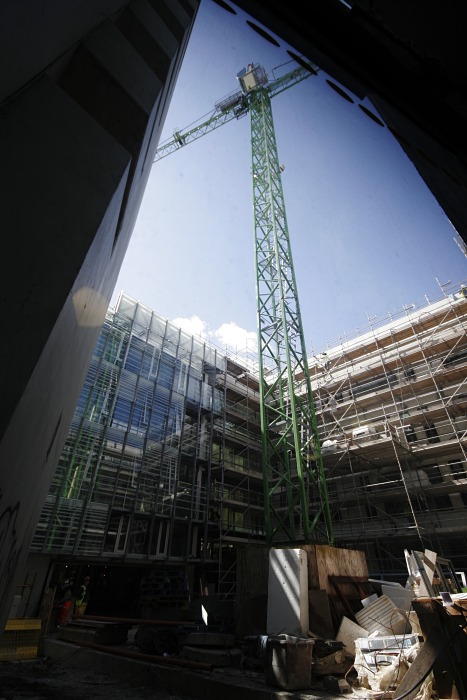
In October 1981, newspapers in the USA and the UK reported
plans for a 169-storey building in Chicago. If this is built, it will be
almost twice as tall as the 384-metre Empire State Building in New
York.
Since the early days of civilised man, buildings have been getting
higher all the time. Today, all large cities have tall buildings, either for
use as offices or as flats. These are called high-rise buildings. The
tallest of a]i in fact, are not used for offices or for living, but are
special structures for radio and television. For instance,Warsaw Radio
Mast in Poland, which is 646 metres tall, is the tallest of such
structures. The world's tallest office building is the Sears Tower in
Chicago. This has 110 storeys, and reaches a height of 443 metres.
16,700 people work inside the building, and there are more than one
hundred lifts for their use.
But why do we have high buildings? Is there any real advantage?
The most common reason given is that in many cities there is a lack of
space.
The island of Manhattan, New York City, is a good example of
this. Here, office space is very expensive. There is no more land.
Buildings have to go up. The same reason is given for high office
buildings in Tokyo, London and other large cities of the world.
But what about people? Is it really necessary to build high
buildings for people to live in?
Today, there are many who believe high buildings actually damage
people's minds and feelings. These people believe high-rise buildings:
-have no advantages, except for their owners and for banks
-are not cheap to build
-do not help create open space
-destroy the landscape
-cause crime
-are not good for children
-are expensive to look after
High-rise buildings lower the quality of life. The following reports
show this. Report from England, 1967: The higher people live off the ground,
the more likely they are to suffer from mental illnesses. Women,
because they spend most time at home, suffer most.
3. The report from Denmark .
a) shows more people live in high-rise buildings in Denmark than in other
countries
b) states the disadvantages of high-rise buildings for children
c) shows how women living in high-rise buildings suffer
d) says that crime rate is higher in high-rise buildings in Denmark than in other
countries
4. Which of the following is not true?
a) The tallest buildings in the world are special structures used as offices.
b) When people live in high-rise buildings, they are cut off from real life.
c) High-rise buildings are still built although they have many disadvantages.
d) Mental illnesses increase especially among women who live in high-rise
buildings
In October 1981, newspapers in the USA and the UK reportedplans for a 169-storey building in Chicago. If this is built, it will be
almost twice as tall as the 384-metre Empire State Building in New
York.
Since the early days of civilised man, buildings have been getting
higher all the time. Today, all large cities have tall buildings, either for
use as offices or as flats. These are called high-rise buildings. The
tallest of a]i in fact, are not used for offices or for living, but are
special structures for radio and television. For instance,Warsaw Radio
Mast in Poland, which is 646 metres tall, is the tallest of such
structures. The world's tallest office building is the Sears Tower in
Chicago. This has 110 storeys, and reaches a height of 443 metres.
16,700 people work inside the building, and there are more than one
hundred lifts for their use.
But why do we have high buildings? Is there any real advantage?
The most common reason given is that in many cities there is a lack of
space.
The island of Manhattan, New York City, is a good example of
this. Here, office space is very expensive. There is no more land.
Buildings have to go up. The same reason is given for high office
buildings in Tokyo, London and other large cities of the world.
But what about people? Is it really necessary to build high
buildings for people to live in?
Today, there are many who believe high buildings actually damage
people's minds and feelings. These people believe high-rise buildings:
-have no advantages, except for their owners and for banks
-are not cheap to build
-do not help create open space
-destroy the landscape
-cause crime
-are not good for children
-are expensive to look after
High-rise buildings lower the quality of life. The following reports
show this. Report from England, 1967: The higher people live off the ground,
the more likely they are to suffer from mental illnesses. Women,
because they spend most time at home, suffer most.
3. The report from Denmark .
a) shows more people live in high-rise buildings in Denmark than in other
countries
b) states the disadvantages of high-rise buildings for children
c) shows how women living in high-rise buildings suffer
d) says that crime rate is higher in high-rise buildings in Denmark than in other
countries
4. Which of the following is not true?
a) The tallest buildings in the world are special structures used as offices.
b) When people live in high-rise buildings, they are cut off from real life.
c) High-rise buildings are still built although they have many disadvantages.
d) Mental illnesses increase especially among women who live in high-rise
buildings
29.5.11
My Basketball Ball
This is my ball. I m play basketball in free time. I like it. It s on the floor. I m play in arena . basket basket basket ohhyeahh. This is my game. this is magic.
Subscribe to:
Posts (Atom)