28.2.09

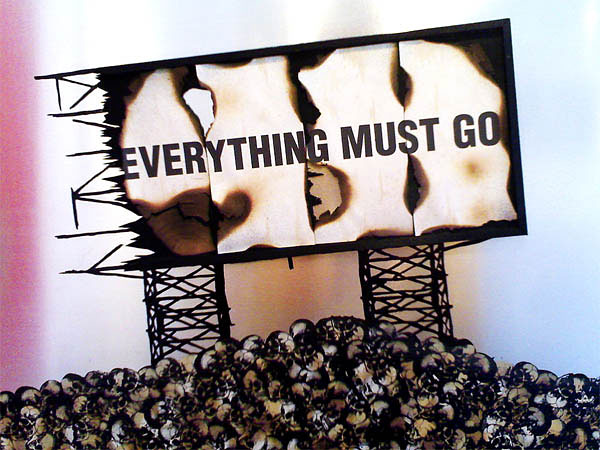
LAW OF CONSERVATION OF MATTER: EVERYTHING MUST GO SOMEWHERE


LAW OF CONSERVATION OF MATTER: EVERYTHING MUST GO SOMEWHERE
We always talk about consuming or using up matter resources, but actually we don't consume any matter. We only borrow some of the earth's resources for a while - taking them from the earth, carrying them to another part of the globe, processing them, using them, and then discarding, reusing, or recycling them. In the process of using matter, we may change it to another form. But we can neither create nor destroy any measurable amount of matter. This results from the law of conservation of matter: In any ordinary physical or chemical change, matter is neither created nor destroyed but merely changed from one form to another. This law tells us that we can never really throw any matter away. Everything must go somewhere and all we can do is to recycle some of the matter we think we have thrown away. We can collect dust and soot from the smokestacks of industrial plants, but these solid wastes must then go somewhere. Cleaning up smoke is a misleading practice, because the invisible gaseous and very tiny particle pollutants left are often more damaging than the large solid particles that are removed. We can collect garbage and remove solid wastes from sewage, but they must either be burned (air pollution), dumped into rivers, lakes, and oceans (water pollution) or deposited on the land (soil pollution and water pollution if they wash away). We can reduce air pollution from the internal combustion engines in cars by using electric cars. But since electric car batteries must be recharged every day, we will have to build more electric power plants.
If these are coal-fired, their smokestacks will add additional and even more dangerous air pollutants to the air; more land will be scarred from strip mining, and more water will be polluted from the acids that tend to leak out of coal mines. We could use nuclear power plants to produce the extra electricity needed. But then we risk greater heat or thermal pollution of rivers and other bodies of water used to cool such plants. Although we can certainly make the environment cleaner, talk of 'cleaning up the environment' and 'pollution free' cars, products, or industries is a scientific absurdity. The law of conservation of matter tells us that we will always be faced with pollution of some sort. Thus, we are also faced with the problem of trade-off. In turn, these frequently involve subjective and controversial scientific, political,economic, and ethical judgments about what is a dangerous pollutant level, to what degree a pollutant must be controlled, and what amount of money we are willing to pay to reduce a pollutant to a harmless level.

26.2.09

BODY LANGUAGE


Perhaps the most surprising theory to come out of kinesics, the study of body movement, was suggested by Professor Ray Birdwhistell. He believes that physical appearance is often culturally programmed. In other words, we learn our looks - we are not bom with them. A baby has generally unformed facial features, i.e. eyes, mouth, nose and chin. A baby, according to Birdwhistell, learns where to set his features by looking at those around - family and friends. This helps explain why the people of some regions of the United States look so much alike. New Englanders or Southerners have common facial characteristics that cannot be explained by genetics. The exact shape of the mouth is not determined at birth, it is learned later. In fact, the final shape of the mouth is not formed until permanent teeth are set. A husband and wife together for a long time often come to look quite alike. We learn our looks from those around us. This is perhaps why in a single country there are areas where people smile more than those in other areas. In the United States, for example, the Southerners smile frequently. In New England they smile less and in the western part of New York State even less. People on Madison Avenue, New York, smile less than those on Peachtree Street in Atlanta, Georgia. Therefore, many Southerners find cities such as New York cold and unfriendly.

SKYSCRAPERS


If someone asked you where the skyscraper was born, what would you answer? Most people would probably say New York City, but they would be wrong. Chicago was the birthplace of the skyscraper. Dictionaries define a skyscraper as "a building of great height which is constructed on a steel skeleton." The first building to fit that description was the Home Insurance Company Building. It was built in Chicago in 1884. It was 10 storeys, i.e. floors, high - a great height for that time. It had a strong framework (structure) of iron and steel instead of walls of stone to support it.The Home Insurance Company Building does not exist any more, they pulled it down in 1931, but visitors to the city can still see other early Chicago skyscrapers. One of them is the 16-storey Reliance Building, which was completed in 1894. The Reliance Building had windows that, for the first time, covered almost the entire surface. For many years, Chicago was behind New York in the construction of skyscrapers. It got back into the competition with buildings like the John Hancock Center, built in 1968. There are luxury flats on forty-nine of the Center's 100 floors. Sometimes people who live on a high floor look out on a sunny sky while those on the downstairs floors can watch the rain from their windows. Architects and engineers have the technology to build even taller structures, but to do this, they must find the money for them and these new skyscrapers should not harm the environment. Back in 1956, the famous architect Frank Lloyd Wright dreamed of a skyscraper of 528 floors. He planned to build it near the shore of Lake Michigan in Chicago. Wright's dream never became a reality, but who knows? Someday somebody may build his tower in the city where the skyscraper was born.


25.2.09

WOMAN PILOT SAVES GANGSTER FROM PRISON


By Michael Field in Paris
A helicopter piloted by a woman carried to freedom a gangster who was serving 18 years for robbery and murder from the Sante Prison in the centre of Paris yesterday. A second prisoner was part of the escape plan, but he changed his mind at the last minute. Michel Vaujour, 34, who his lawyer describes as a dangerous criminal of above average intelligence, was waiting on the roof when a white helicopter flew in and took him away. It was the fourth and most exciting escape in Vaujour's career. The helicopter took off from the suburb of St. Cyr and flew in without paying attention to radio warnings from the police that it was breaking the ban on low flying over Paris. Two people were on board: a woman with dark brown hair dressed in black and a man with a sub-machine gun. An hour after the breathtaking escape, the prison governor told reporters, "The helicopter dropped a rope ladder to help Vaujour climb aboard while the man with the sub-machine gun told prison guards not to move. The whole operation took only about two minutes. Fortunately, no shots were fired and nobody was injured." The helicopter landed soon after at a nearby football field. Some children playing there saw two men and a woman run off towards a ring road. Claude Roumet, head of Air Continent which owned the helicopter, said, "A pretty woman about 28 years old, who gave her name as Lena Rigon, rented the helicopter. She is a regular customer and has been flying my aircraft for five or six months. I was really surprised when I heard that she did this incredible thing." Five years ago, another helicopter escape took place in Paris. Two prisoners escaped from the Fleury-Merogis prison south of Paris, but they could not go very far because the, police quickly recaptured them.

24.2.09

THE WORLDS OF WALT DISNEY


Disney World are the two most famous entertainment parks in the world. Disneyland is in California and Disney World is in Florida, U.S.A. These were built by Walt Disney. Walt Disney started to make cartoon films in 1923 with his brother 5 Roy. First he made 'Alice in Wonderland' and then, in 1928, Mickey Mouse was created. He was very interested in technology so all his work was technically excellent and very enjoyable. He believed in providing good, clean entertainment and fun for all the family. He wanted a world which would give him a lot of fun when he was a boy 10 and so he built it for others to enjoy in Disneyland, which was opened in Anaheim, California in 1955. It has four parts: Adventureland, Frontierland, Fantasyland and Tomorrowland. In 1960 Walt Disney bought a big piece of land near Florida and started to build his second great entertainment park. This was called 15 "Disney World". It was finished in 1971 and cost 400 million dollars. This place is a little different from Disneyland. It has got hotels and shopping centres as well as entertainment places. So people can eat, sleep and enjoy doing things in the same place. A few years ago two other small cities were planned near Disney 20 World. One of them is called Lake Buena Vista. This has been completed and people have started to move in. They are still building ihe second city so people will not move in until 1995. Walt Disney died of cancer in 1966, but people still remember him when they visit his parks today.Disneyland and

18.2.09

MONEY THEN AND NOW


When you buy something these days, you have so many ways of paying for it. Just think of them! However, you may be surprised to learn that there have always been lots of methods of payment. In very early times, people used to exchange one thing for another - an ox or a cow for rice or grain, for example. This system of exchange was called 'barter', but there were lots of problems. Well, how many heavy bags of rice would you give for a cow ... or a TV, or a car? And how would you carry the bags of rice? The ancient Greeks solved these problems. In the 7th century B.C. they introduced coins made of fixed amounts of gold and silver.Business became much easier, because people could now exchange money for the things they required. Coins last a long time, but they are heavy, and so eventually, governments solved the problem by introducing banknotes. So cash became easier and lighter to carry. Nowadays, of course, more and more people are paying for things with cheque's and credit cards instead of in cash. What is the reason for this?

17.2.09

AMERICAN CITIES


We can trace all the problems of the American cities back to one starting point: we Americans don't like our cities very much. That is strange. More than three-fourths of us now live in cities, and more are flocking to them every year. We are told that the problems in our cities are receiving more attention in Washington. However, it is historically true: in the American psychology, the city has been a basically suspect institution. Americans have related urban areas to Europe, which they believed to be full of dishonesty and illegal behaviour. Moreover, they believed that cities lacked spaciousness and innocence, so easily found in rural areas. Therefore, it can be said that a strong anti-urban attitude runs through American thinking. The settlement of America was a reaction to the harsh conditions in European industrial centres. People came to America because there was available land and they wanted to escape from the bad influences of thecities.

What has this got to do with the unpleasant situations of the modern cities? I think it has a lot to do with it. The United States has never thought that the American cities were worthy of improvement. It was believed that cities should support themselves. The reason behind this is not directly the result of a 'the city is evil, and therefore, we will not help it attitude. It is more indirect. Billions of dollars are spent to preserve the family farms but nothing is done about an effective programme for jobs in the cities. In addition, although there have long been government agencies which deal with agriculture, small business, veterans and commerce, the Department of Urban Development wasn't set up until 1965. Now consider this: the most important housing law was not the law that provided public housing; it was the law which provided low-interest mortgages for Americans who wanted to buy a home. More than anything, this made the suburban dream a reality. 800,000 middle-class New Yorkers left the city for the suburbs dreaming of grass and trees and a place for their children to play in. They were replaced by unskilled workers, who represented a further cost to the cities. which doesn't deserve support or help in the minds of Americans.